Present Moment Leadership is a research-informed framework from the Center for Innovative Leadership at the Johns Hopkins Carey Business School. Learn how to assess each situation and flex empathy, competence, and agility to meet changing workplace demands.
Leaders often have to act before a situation is fully clear. A team may need direction even as new information calls an earlier decision into question. CIL’s Present Moment Leadership white paper helps leaders examine choices like these through a guiding question:
What does this moment ask of me as a leader?
For practitioners and researchers, the white paper provides a shared language for considering why a response that works in one setting may fall short in another. It explores the habits leaders bring to their work, the signals they might miss, and the choices available when they pause to take stock.
Download the PML white paper to see how PML can sharpen leadership judgment when the path forward is uncertain.
Present Moment Leadership (PML) is a research-informed framework for leading and developing leaders in contemporary work environments characterized by rapid change, competing priorities, uncertainty, and interdependence. Building on behavioral and situational leadership scholarship, the framework shifts attention from applying predetermined leadership styles to interpreting and responding to the specific demands of each leadership moment.
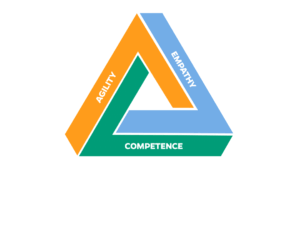
PML organizes leadership behavior around three interrelated elements: empathy, the capacity to understand and respond to others’ perspectives and needs; competence, the ability to apply expertise, judgment, direction, inquiry, and facilitation; and agility, the capacity to gain perspective, adapt, reframe, experiment, or maintain course as conditions evolve. The framework emphasizes that these elements are always available but should be flexed, intensified, moderated, or expressed differently in response to situational demands. It also presents leadership development as a process of expanding both the range and precision with which leaders can access and apply these behavioral resources.
Through illustrative scenarios involving decision-making under pressure, organizational learning, strategic disruption, and suspected misconduct, the paper demonstrates how effective leadership requires sequencing and recalibrating behaviors over time. PML offers leaders, coaches, educators, and organizations a practical language for reflection, development, and translating leadership research into context-sensitive action.