Summary
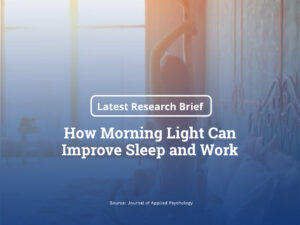
Whether and when employees encounter blue light may matter for how well they sleep and work. A field experiment found that wearing glasses that emitted blue light in the morning improved sleep that night, with benefits for alertness and mental energy the following day. The findings give leaders a broader view of employee recovery: supporting better sleep can begin in the morning, with implications for subsequent engagement, task performance, and assistance of colleagues.
The conditions behind a productive workday
Leaders depend on employees being able to concentrate, sustain effort, and contribute to the people around them. Yet the capacity to do those things varies from day to day. A demanding assignment may feel manageable after a restorative night and considerably harder after poor sleep. Understanding these fluctuations means paying attention to the conditions that help people arrive ready to work.
Research by Kathleen R. Keeler, Christopher M. Barnes, Yiming Huang, CIL Core Faculty Brian C. Gunia of the Johns Hopkins Carey Business School, and Jason H. Moy examined one condition that organizations rarely connect to work performance: exposure to blue light early in the day. Their study explored whether a brief morning intervention could improve subsequent sleep and, through that recovery, employees’ experiences and behavior at work.
Getting to the source of the problem
Blue light often enters discussions of sleep through concerns about evening screen use. Earlier organizational research had found benefits from filtering blue light at night. But the body’s internal clock responds differently to light depending on when exposure occurs. The researchers drew on evidence that morning blue light helps align the daily sleep-wake cycle, potentially making it easier to fall asleep and sleep well later that night.
This raised a practical question: could deliberately increasing morning blue light exposure improve employees’ work outcomes? The research also examined how any benefits might emerge. Feeling alert and energetic is different from having enough mental capacity to sustain effort and regulate behavior. Better sleep could support both, with different consequences for how people work.
A morning intervention with benefits the next day
The experiment involved 182 full-time employees at a university who worked regular daytime schedules. Over two workweeks, participants wore blue light emitting glasses for 30 minutes immediately after waking. Each person experienced one week at full intensity and one week at a low-intensity control setting, with the order randomly assigned and the different intensities undetectable to participants. This allowed the researchers to compare each employee’s experiences across the two conditions.
Morning exposure at full intensity improved self-reported sleep duration and quality that night. Both longer sleep and better sleep quality were linked to greater alertness the next morning. Better sleep quality was also linked to feeling less mentally depleted, but the relationship between sleep duration and mental depletion was less clear.
These changes connected to work in distinct ways. Greater alertness was associated with stronger engagement and more helping behavior, such as taking time to advise a colleague. Feeling less mentally depleted was associated with better task performance, stronger engagement, and fewer behaviors that undermined work. The findings suggest that recovery can support both the energy to contribute and the capacity to stay on task.
The timing matters. For someone using the glasses on Monday morning, the sequence examined ran through Monday night’s sleep to Tuesday’s workday. Additional analyses found no significant same-day effects on alertness or work outcomes. The evidence pointed toward benefits carried through subsequent sleep.
Exploratory analyses suggested that employees with existing sleep difficulties experienced greater improvements in sleep quality, while younger employees experienced greater gains in sleep duration. These preliminary patterns warrant further study.
What This Means for Leaders
The study expands the way leaders can think about supporting employee recovery. Sleep-related initiatives can address the full daily cycle, including morning routines and light exposure. For organizations considering a voluntary well-being pilot, the research provides a specific intervention to evaluate and a reason to assess both sleep quality and daytime functioning.
The distinction between alertness and mental depletion also matters when interpreting performance. An employee who feels more energetic may be more inclined to engage with colleagues, while sustaining attention to core responsibilities may depend on feeling mentally restored. Leaders should be cautious about treating visible energy as a complete indicator of someone’s capacity to work effectively.
The evidence supports measured experimentation. The study lasted two weeks, involved employees from one university, and relied on self-reported sleep and work outcomes. It did not study the possibility of longer-term benefits, objective productivity gains, or effectiveness for shift workers. It also tested specialized glasses, so the results cannot be assumed to apply equally to brighter screens, ordinary office lighting, or time outdoors.
Supporting the next workday
The research invites leaders to consider how the conditions of one day carry into the next. Supporting employees’ ability to contribute includes attention to the recovery that makes sustained effort possible. Morning light offers one promising avenue to explore, alongside work practices that leave people adequate opportunity to rest.
Access the full research paper here: Keeler, K. R., Barnes, C. M., Huang, Y., Gunia, B. C., & Moy, J. H. (2026). Rise and shine: Morning blue light exposure, sleep, and work. Journal of Applied Psychology. https://doi.org/10.1037/apl0001418