
Each year, MBA students from across the country gather at the Johns Hopkins University Bloomberg Center in Washington, D.C., for an experience designed to test and expand how they lead under pressure.
The atmosphere in the room was charged with anticipation. Dozens of candidates from the Johns Hopkins Carey Business School’s part-time, online Flexible MBA program, and professionals looking for new development opportunities, had gathered from all over the country for a three-day course about learning to lead through crisis. Around the room, easel-sized sticky paper spelled out their sources of uncertainty and unexpected circumstances—real professional challenges—so they could find others with the same challenges and talk through them when they had the opportunity.
Over three days in March 2025, the intensive course participants absorbed the nuances of decision-making, teamwork, and realistic problem-solving. They knew it would be rich with learning and networking, but they had no idea what else would be coming: one of the most transformative long weekends in their academic and corporate lives so far.
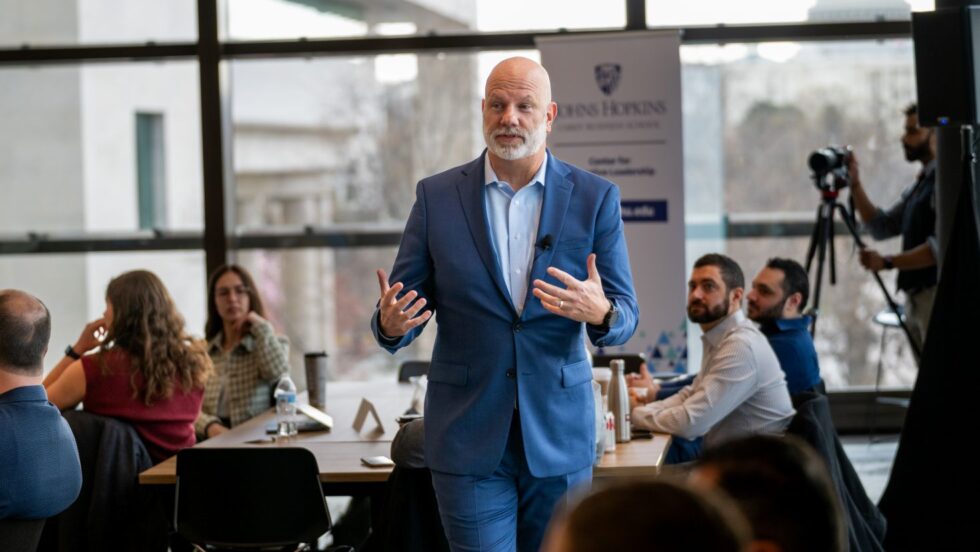
“Innovative Leadership in Uncertain Times,” an intensive in-person course designed around a realistic crisis scenario, thrusts students into a high-stakes, high-pressure simulation that forces them to respond to disaster. Hosted by the Johns Hopkins Carey Business School’s Center for Innovative Leadership and led by Professor Christopher G. Myers, the weekend at the Johns Hopkins University Bloomberg Center in Washington, D.C., combines research and instruction with expert engagement and faculty-developed trial by fire.
The first ILiUT
In an early session of the 2025 weekend, students got an interactive understanding about what it takes to be a high-reliability organization, or HRO: essentially, a permanent sense of discomfort built from a preoccupation with failure, a reluctance to simplify sensitivity to operations, deference to expertise, and a disposition toward resilience.
Resilience, said Myers, is not something one has; it’s something one does. It comes in part from refusing to fall into dysfunctional momentum: working toward a goal without reevaluating, recalibrating, or reexamining processes. In short, no organization can be highly reliable if its leaders pay so much attention to preventing things from going wrong that they never learn how to deal with things going wrong.
“[Myers] said HROs don’t know that they are HROs,” said James Albino, a Navy veteran with extensive leadership service in the Department of Veterans Affairs who earned his MBA from Carey in 2022 and came to the weekend intensive for further development. “Their culture is that way. They incorporate these attributes. Somehow, organizationally, leaders have created that resilience, that commitment to sensitivities in operations that make them an HRO without having a checklist.”
When participants broke into assigned groups to work on the weekend’s central challenge, they immediately learned how well and how quickly they could become, or fail to become, an HRO.
All at once, they received their case—one that threatened the reputation and survival of the company they were running. Now they were up against a clock to diagnose the problem, propose short- and long-term solutions, address their board, handle the media, and keep the rest of the company going. Curveballs came without warning, and they worked late into the night.
Jessica Ross, a California-based sales enablement specialist at Huntington Bank and a Carey Flexible MBA candidate, found the challenge intense.
“I’ve never had a class where we had the time to be able to have not only that first case study, but follow-up emails getting more information every half hour to an hour until it’s completed,” she said. “It really felt like we were in the hot seat and this was our crisis to handle. It definitely felt like we were actually presenting to a board and getting bombarded.”
While Ross was one of the youngest participants, even those with many years of experience found that the challenge lent new insights to their understandings of themselves. Albino, for example, realized his introvert tendencies showed up: he was retreating from the group, and that wasn’t going to help solve anything.
“I was immediately aware of what was going on there,” he said. “I learned in this experience that, when the dysfunction starts to happen, we need to stop, take notice, take a breath, and regroup.”

Motivation, inspiration, perspiration
But before the perspiration of that high-stress challenge, there was inspiration.
Participants heard from Karen Peetz, a Carey alumna who, as a senior vice president in 2001, steered BNY Mellon through the attacks on September 11 and the financial world’s challenges afterward. She was the bank’s CEO of Financial Markets and Treasury Services during the financial crisis of 2008, when the bank received the assignment from the Department of the Treasury to track which firms were receiving the financial system-stabilizing Troubled Asset Relief Program, or TARP, funding, and how much. She later became BNY Mellon’s president.
An undergraduate alumna of Penn State University, she happened to become chair of its board when legendary head football coach Joe Paterno and his assistant coach, Jerry Sandusky, were embroiled in a sexual assault scandal that rocked not just Penn State but all of college athletics. And she was a Johns Hopkins trustee when the COVID-19 crisis hit, just as she became the chief administrative officer at Citi.
What she learned and drew on through all of her experience was what she called the “arrogance of optimism”—a concept that aligns with being a high-resiliency organization.
“If everything’s just going so, so great, it might not be sustainable,” Peetz told the participants. “There might be some risk around the corner that you weren’t expecting. It behooves leaders to constantly be looking at the downside.”
Participants came away admiring Peetz tremendously.
“In my own experience, I have encountered these things, but not in as positive a light as she has,” Albino said. “She seems to embrace discomfort, and that’s one of the key concepts of the course.”
Present Moment Leadership
The guiding principle behind CIL’s leadership framework is what Myers and his co-director, Mike Doyle, call Present Moment Leadership. Backed by decades of research, including their own, the philosophy encourages developing leaders to ask themselves what the current moment demands and adjust three core elements of leadership to meet it: empathy, agility, and competence. It’s essentially the philosophy that helped Peetz lead effectively.
Albino found PML to be an effective outgrowth of mindfulness, one that can help keep an individual or a team from focusing on the wrong thing at the wrong time. He saw this start to happen in his case group and realized the team needed to apply PML.
“I embrace that approach,” he said. “It helps sequence the events. What is it we need in the moment, rather than going to the end?”
Integrity and accountability were recurring themes during the ILiUT weekend, and Ross came away with a new perspective at just the right time for her professional trajectory.
“I think it helps me understand why leaders make the decisions they do,” she said. “Especially being so early in my career, I don’t have a whole lot to compare it to. Learning about these case studies and companies gives me more of a comparison to make sure I’m on the right track and the company I work for and its leaders are following certain leadership styles.”
A lasting impact
Spending time in person with other participants, whether in new or long-established careers across industries, gave both Ross and Albino the sense that ILiUT is a uniquely sophisticated course. Neither had been so impressed with either the course design or the members of a cohort before.
“I did not expect the level of interactive engagement with the rest of the students, and I welcomed that,” Albino said. “In my other experiences, not everybody was at the level of enthusiasm and intellect that was in that room.”
“I gained confidence in my own abilities and in my ability to work in a team, which is something I do in my day-to-day,” said Ross. “It was really great to learn from my classmates. It was one of the most memorable classes I’ve ever taken.”
The next ILiUT course will begin August 7, 2026. Registration opens March 23, 2026.